Deploy your project
Deploy your project to a testing, staging, or production environment.
Deployment stages
The deployment pipeline has the following stages:
| Stage | Description |
|---|---|
| Development | Use to create and test new software features and changes. |
| Testing | Use for quality checks, ensuring software meets defined standards before release. |
| Staging | Use for controlled testing where changes are validated before deployment to production. |
| Production | The live system with the latest software. Only administrators and organization owners can deploy to this stage. |
To define your deployment pipeline stages, follow the connect clusters instructions.
- For each stage, an administrator must define the cluster to deploy to. Deployments can only be made to the pre-defined set of approved clusters. An Undefined stages warning is shown if no cluster is selected for at least one stage.
- Each deployment action is logged with information on the user and stage it was deployed to.
Prerequisites
Make sure you've set up a project, including at least one cluster.
Only users with correct privileges can deploy:
- If the target cluster has authorizations enabled, ensure deploying users have
CREATEpermission to theRESOURCEresource type. - Configure your deployment settings
Deploy your project
Once you've validated your process, deploy your project to cluster stages in your development lifecycle, such as testing, staging, or production. For example, deploy to your testing cluster to run automated tests or make it available for testing.
- In your workspace, open a project.
- At the top right of the project view, click the Deploy & run combo button, and select Deploy latest changes. This opens the deployment modal.
- Select the cluster stage to deploy to. The next stage is not automatically selected. You must select the stage you want to promote to.
- If the cluster is paused, you must resume it.
- Click Deploy to deploy the project to the selected cluster.
When you deploy from the project homepage, all BPMN, DMN, and form files in the project are deployed as a single bundle.
If any resource fails to deploy, the whole deployment fails and the cluster state remains unchanged. This safely ensures that a project cannot be deployed incompletely or in an inconsistent state.
In Self-Managed, you can deploy your project to the cluster defined in your Camunda Hub configuration.
If you don't want to deploy all resources in a project, you can deploy an individual resource.
Run your project
You can manually run your project to test it after it has been deployed to a testing, staging, or production cluster.
Use Test mode to validate and debug your project against any environment. Use Run to execute a full process instance of your already-deployed project, for example to exercise your real job workers and APIs on a testing, staging, or production cluster.
To run your project:
- In your workspace, open a project.
- At the top right of the project view, click Deploy & run to open the Deploy & run modal.
- Select the process for which you want to start a new instance in Process to run.
- Select Deploy & run to start a new instance.
- Before the process instance starts, all resources are redeployed if required so the new instance uses their latest state.
- After the process instance starts, you will receive a notification with a link to the process instance view in Operate. Open this link to monitor the process instance.
You can also open the Deploy & run modal from the details page of any BPMN file in the project. In that case, the current process is run and the modal includes an additional option to select the resources to deploy.
If the target cluster has authorizations enabled, make sure you have the following permissions to be able to view the process instance in Operate:
| Resource type | Permission |
|---|---|
PROCESS_DEFINITION | READ_PROCESS_DEFINITION and READ_PROCESS_INSTANCE |
COMPONENT | operate |
Deployment errors
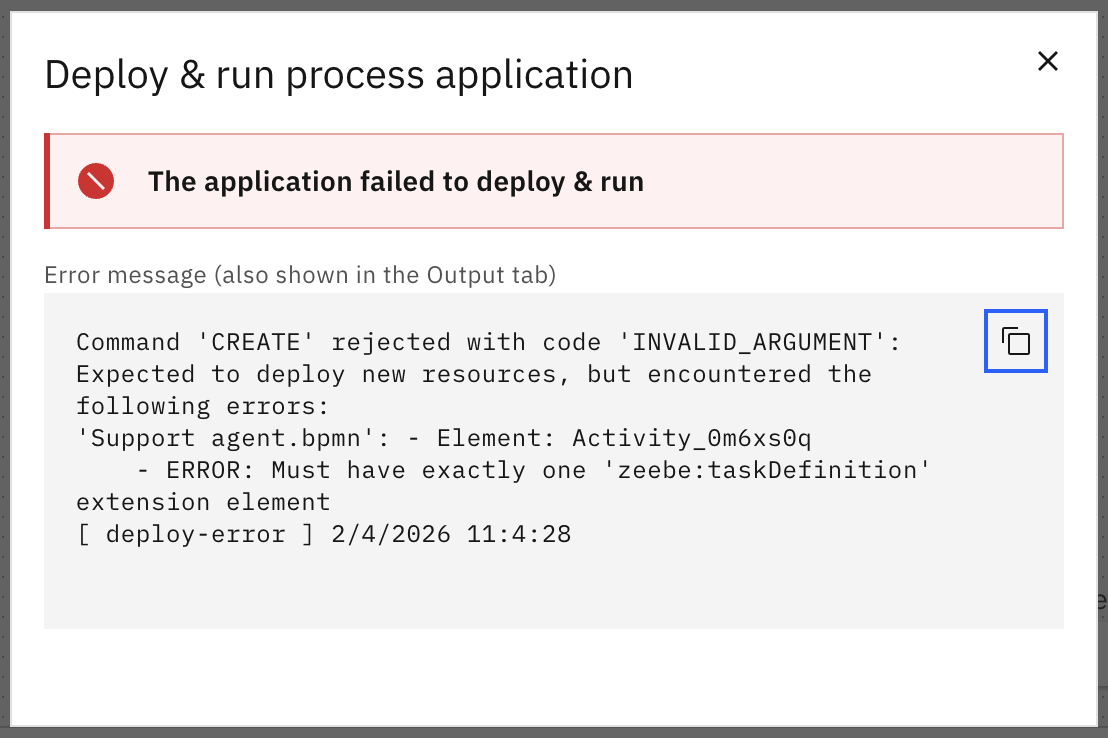
If the deployment of a project fails (for example, because one or more of the contained resources has invalid implementation properties), a modal is shown containing the error message thrown by the Zeebe engine.
The message typically provides the name of the affected resource, the ID of the invalid diagram element, and the error details.
Deployment of external resources
You can link BPMN processes, DMN decisions, or forms that are not part of the project itself (external resources) from any process inside a project. When you deploy the project, linked resources located outside the project are not deployed with the project, so you must deploy them separately.