Introduction to Camunda 8
Use Camunda 8 to orchestrate and automate complex business processes that include people, AI agents, systems, and devices.
About Camunda 8
You can deploy Camunda 8 in two ways:
- Camunda 8 SaaS: A fully managed cloud service for rapid deployment and minimal operational overhead.
- Camunda 8 Self-Managed: A self-hosted solution for organizations requiring full control over their infrastructure.
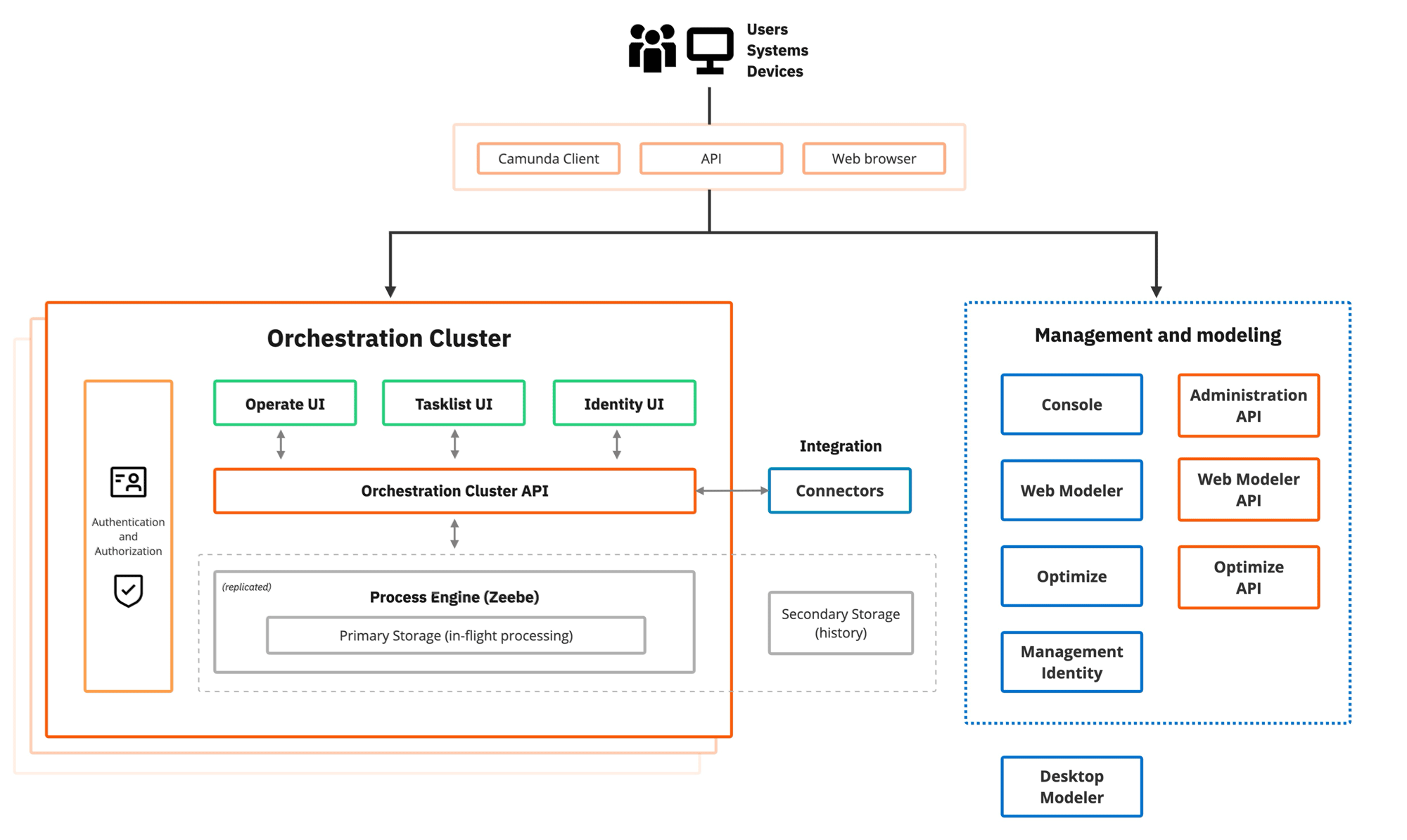
Camunda 8 combines powerful execution engines for BPMN processes and DMN decisions with tools for collaborative modeling, operations, and analytics. Camunda 8 components work together to form the complete Camunda 8 experience, allowing you to design, automate, and improve your business processes.
- Want to migrate your Camunda 7 process solutions to run on Camunda 8? See our Camunda 7 migration guide.
- Deployment guides for Camunda 8 components are available in the Self-Managed section.
Camunda 8 use cases
With Camunda 8, you can model, execute, and operate complex business processes from end to end.
Most real-world automation is distributed. A single business outcome (for example, customer onboarding, claims handling, or order fulfillment) often requires many independently deployed services and external systems. That makes it hard to keep the overall process visible, understand where work is waiting, and recover cleanly when something fails.
Camunda provides a process orchestration layer that coordinates these endpoints without forcing you into a tightly-coupled architecture. You define process and decision logic using BPMN and DMN, then run it on a stateful, event-driven workflow engine designed for long-running, high-volume execution. This gives teams a consistent way to trigger work, correlate events, handle retries and compensation, and troubleshoot incidents across the full business process, not just within a single service.
Many processes also require human input, either as a normal step (for example, review or approval) or as a fallback when automation can't proceed. With Camunda, you can model human tasks alongside automated steps, then assign, track, and escalate work so the process keeps moving. For example, if customer onboarding is blocked waiting for a verification task, the process can route to the right person, enforce due dates, and make the delay visible in operations tooling.
Camunda also supports agentic orchestration. You can treat AI agents as process endpoints, just like a microservice or API call, and orchestrate them together with deterministic steps and human checkpoints. You can also build agents in Camunda by modeling agent behavior such as planning loops, tool use, and reflection, including short-term and long-term memory and retrieval-augmented generation (RAG). This makes agent actions observable and auditable, and it helps you combine dynamic agent decisions with the guardrails and policies your process requires, such as role-based access control, compliance boundaries, incident recovery capabilities, and audit trails.
Common use cases include orchestrating microservices across complex integrations, modernizing long-running processes that cross legacy systems, coordinating human work with automation, and running AI-assisted steps (for example, document interpretation or decision support) inside governed, end-to-end processes.
What are the core quality attributes of Camunda 8?
Camunda 8 is designed to operate on a very large scale. To achieve this, it provides:
- Horizontal scalability and no dependence on an external database; Zeebe (the workflow engine inside Camunda 8) writes data directly to the file system on the same servers where it is deployed. Zeebe enables distribution processing across a cluster of machines to deliver high throughput.
- High availability and fault tolerance via a pre-configured replication mechanism, ensuring Camunda 8 can recover from machine or software failure with no data loss and minimal downtime. This ensures the system as a whole remains available without requiring manual action, which is particularly critical for AI-assisted processes, where every agent decision and action must be traceable end-to-end.
- Audit trail as all process-relevant events are written to an append-only log, providing an audit trail and a history of the state of a process.
- Reactive publish-subscribe interaction model which enables microservices that connect to Camunda 8 to maintain a high degree of control and autonomy, including control over processing rates. These properties make Camunda 8 resilient, scalable, and reactive.
- Visual processes modeled in ISO-standard BPMN 2.0 so technical and business stakeholders can collaborate on process design in a widely-used modeling language.
- Language-agnostic client model makes it possible to build a client in nearly any programming language an organization uses to automate work.
- Operational ease of use because, as a SaaS provider, we take care of all operational details.
What are the Camunda 8 components?
Modeler
Design fully-executable process and decision models that reduce misalignment and handoff friction while giving engineers the freedom they need to build the right solution. Camunda Modeler gives business users an intuitive way to model processes and decisions using the BPMN and DMN standards so their intent is clear, structured, and directly usable by developers. Developers can take the model as-is and build scalable, flexible solutions without worrying about losing alignment with business intent. Available via web and desktop app.
Connectors
Connectors communicate with any system or technology, reducing the time it takes to automate and orchestrate business processes. Outbound Connectors trigger events outside of Camunda, while inbound connectors allow processes running on Camunda to receive messages from external systems. Connectors also serve as the tool layer for AI agents, enabling agents to interact with external systems in a governed, reusable way. Browse connectors in Camunda Marketplace.
AI agents
Build enterprise-grade AI agents with guardrails so they can solve complex problems with autonomy. Camunda implements agentic BPMN that enables teams to model deterministic process logic and dynamic agentic behavior, such as reasoning loops, memory, prompts, RAG, and human‑in‑the‑loop boundaries, in one unified, executable model.
Forms
Some automated processes require human contribution and interaction. Create and implement custom forms that give work instructions, collect information, and help people make decisions about the tasks they need to complete.
Tasklist
Tasklist offers a lightweight, user-friendly interface for human work, tightly integrated with custom forms. It provides an out-of-the-box user interface for tasks so teams can rapidly iterate on process development without having to build a custom frontend application.
Workflow and decision engine
Zeebe is a distributed workflow and decision engine that replaces a traditional relational database with an event streaming, message-based architecture. This approach eliminates database bottlenecks, ensures horizontal scalability, and provides built-in resilience.
Operate
With Operate, teams can monitor running processes, troubleshoot and resolve incidents, and modify and migrate process instances. Trace process flows in real time, investigate failures, modify variables, and resume execution where needed, all within the context of the end-to-end business process. For AI-assisted processes, Operate provides visibility into agent actions and decisions at runtime, enabling teams to detect and resolve unexpected behavior.
Optimize
Optimize leverages process execution data to continuously provide actionable insights. Optimize specializes in BPMN-based analysis and can show users exactly what their process model needs for successful execution.
Console
With Console, teams can create, configure, manage, and monitor clusters for all environments, from development to production. Console offers control over organizational settings such as user and role management, and provides insights into usage metrics.
How does Camunda 8 compare to other solutions?
Composability
Camunda's integrated yet flexible architecture facilitates best-of-breed technology and reuse. Combine Camunda task automation with other tools and custom code for maximum flexibility. Choose SaaS or Self-Managed, and use your preferred cloud, Kubernetes, and identity provider.
Open architecture
Integrate with a variety of applications, systems, and services to scale your architecture. Camunda works with your preferred source control, CI/CD pipelines, and programming languages, while well-documented APIs, SDKs, and polyglot clients enable easy integration and customization.
IT and business collaboration
IT and business stakeholders build and test processes in a shared modeling environment using the shared languages of BPMN and DMN. Reusable process assets such as connectors and AI agents make it easy to onboard new teams.
Scalability
Event streaming avoids database bottlenecks and can scale process throughput in a highly effective way. Camunda's distributed architecture ensures continuity in the case of hardware or network failure and supports replication across global data centers for high availability.
Intelligence
Camunda enables teams to embed AI agents into governed business processes, combining autonomous agent reasoning with the auditability and compliance controls that enterprise operations require.
Next steps
- To request information about Camunda 8 performance and benchmarking, refer to our Contact page.
- Introduction to Camunda 8
- Create a Camunda 8 account
- Migrate from Camunda 7 to Camunda 8
- Automate a process using BPMN
- Build your first AI agent